Rahman syndrome: when chromatin fails to compact
20 July 2026
Rahman syndrome is a rare genetic disorder associated with neurodevelopmental disorders and characteristic facial features, which may also be accompanied by skeletal or cardiac abnormalities. In an article published in Nature Communications, scientists from the IBS, the IAB, the IGBMC, and research institutes in Turkey and Bulgaria show that the mutation responsible for this disorder prevents a protein, histone H1.4, from properly compacting DNA. This disruption could alter the expression of many genes during development.
H1.4, a chromatin-linker histone that compacts chromatin and causes Rahman syndrome
Rahman syndrome is a rare genetic disorder associated with neurodevelopmental disorders and characteristic facial features, with highly variable clinical manifestations that may include premature aging, cardiac or skeletal abnormalities, or visual and behavioral disorders. It is caused by mutations in the gene encoding histone H1.4, one of the linker histones found in humans. This family of proteins helps organize chromatin and thus influences DNA compaction and its accessibility within the nucleus.
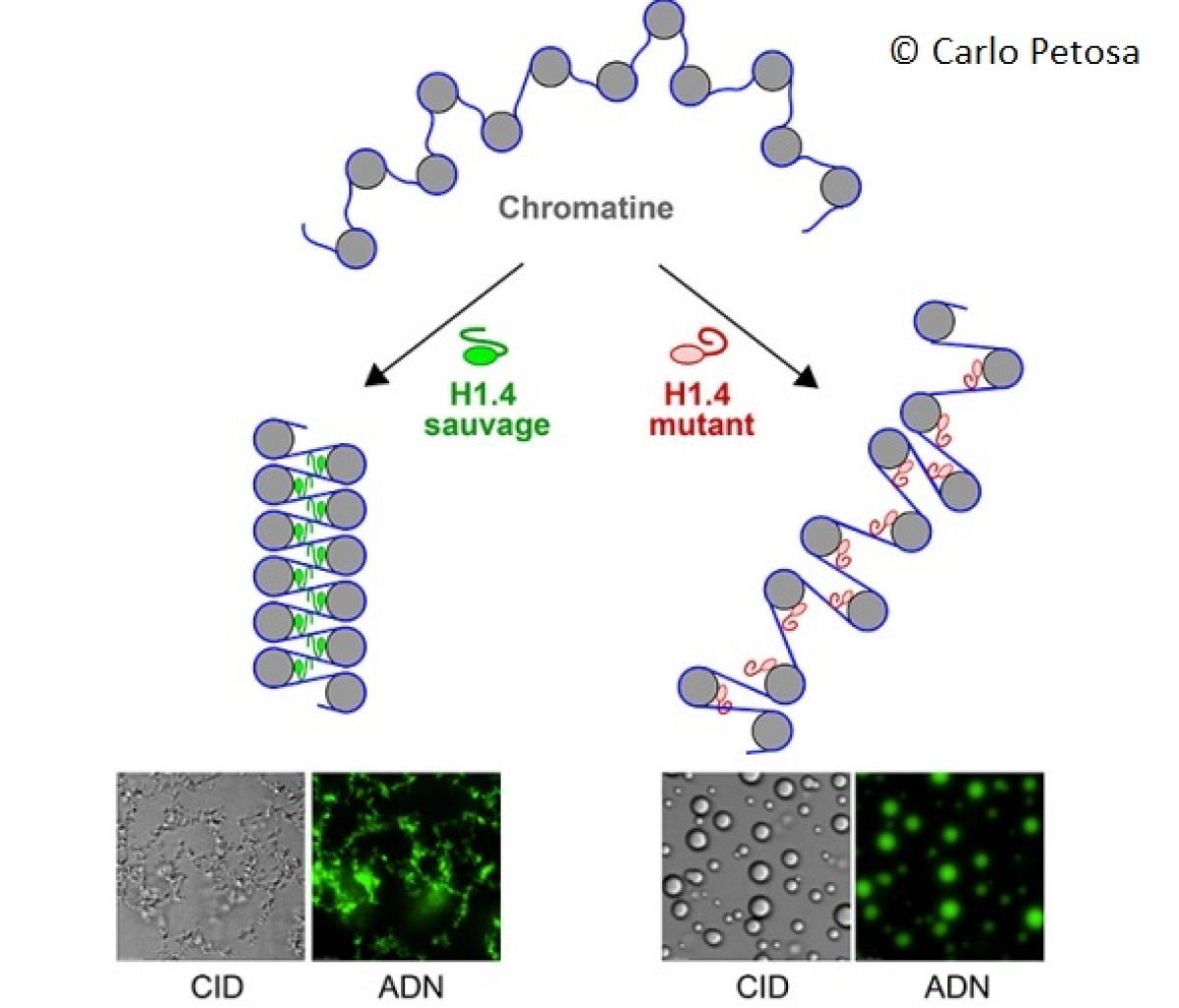
In the nucleus, DNA is wound around proteins called “core” histones to form nucleosomes, the basic units of chromatin. Nucleosomes are linked together by short segments of DNA. Unlike core histones, linker histones such as H1.4 bind at the entry and exit points of the DNA on the nucleosome. H1.4 thus acts as a kind of molecular clip: it helps bring these two DNA segments closer together and stabilizes a more compact chromatin structure. This compaction influences the accessibility of DNA to the molecular machinery that reads, copies, or repairs genetic information.
H1.4 contains a long, flexible region rich in positive charges, which facilitates its interaction with DNA and chromatin compaction. Mutations associated with Rahman syndrome alter this region and reduce its positive charge. For this study, published in the journal Nature Communications, the scientists focused on the mutation most frequently identified in patients with this syndrome.
More open chromatin and more accessible DNA
To understand the impact of this mutation, the scientists combined several complementary approaches: experiments on nucleosome chains reconstructed in the laboratory, analyses of chromatin in cells, and computer simulations.
The results show that the mutated form of H1.4 is less effective at bringing together the DNA segments connecting nucleosomes. Chromatin then adopts a more open and flexible structure, in which nucleosomes are stacked less regularly and where the DNA becomes more accessible. The scientists also observed that this mutation alters the physical properties of chromatin. While the wild-type protein promotes the formation of fibrous condensates through phase separation, the mutant protein significantly reduces the ability of nucleosome chains to form condensates, which instead take on the appearance of spherical droplets. Taken together, these observations show that the mutation impairs the structural function of H1.4.
Toward a Better Understanding of Chromatin-Related Diseases
This research establishes a direct link between a mutation in H1.4 and chromatin disorganization that can alter the expression of numerous genes during development. It thus provides an initial molecular explanation for the abnormalities observed in patients with Rahman syndrome.
Beyond this rare disease, this study highlights the central role of binding histones in the three-dimensional architecture of the genome. It provides a framework for better understanding other diseases linked to defects in chromatin organization and opens up new avenues for studying the mechanisms that control gene expression.
Article originally published by the CNRS
Bibliography:
A Rahman Syndrome mutation in histone H1.4 disrupts chromatin compaction and phase separation
Boopathi R, Garcia-Saez I, Turunç S, Lone IN, Kumar A, Abu Alhaija AA, Hayes JJ, Bednar J, Diril MK, Iliev D, Gospodinov A, Le Roy A, Skoufias D, Angelov D, Hamiche A, Kale S, Dimitrov S, Petosa C.
Nat Commun. 2026 May 22. doi: 10.1038/s41467-026-73046-8