Our research axes
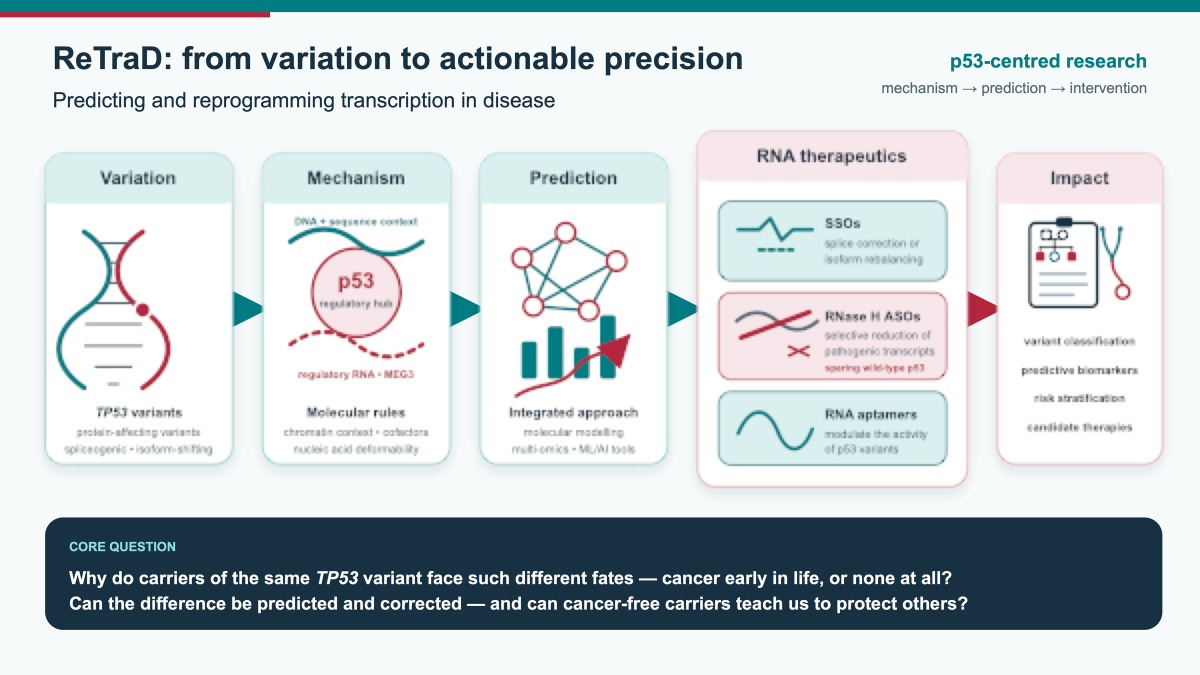
Predicting and reprogramming transcription in disease (ReTraD)
Rules of p53 transcriptional decisions
p53 activates, represses or ignores a gene depending on context, and the choice cannot yet be predicted from sequence. We showed that response elements extend beyond their core motif, that transcription factors alter DNA torsional rigidity in family-specific ways, that one methylation mark can break cooperative binding, and that a nuclear receptor reads DNA and RNA differently. We now apply these rules to p53, ranking response elements genome-wide by their ability to bind wild-type, mutant and hypomorphic p53, and asking whether tissues differ in the elements used. Expected value: context-aware prediction of transcriptional outcome.
TP53 variants, splicing and isoform balance
Why do carriers of similar TP53 variants develop different cancers, at different ages, or none at all? Part of the answer is invisible to protein assays: substitutions can activate cryptic splice sites, causing frameshifts and premature stops. We identified 58 spliceogenic exonic variants and confirmed aberrant splicing for 15 of 17 tested; carriers once called mild showed earlier onset. Intronic variants differ in how far they disrupt the transcript; some retain a hypomorphic, partly functional p53, with onset delayed by about 15 years. Variants also shift p53 isoform balance across tissues.
Expected value: reclassification of variants of uncertain significance and risk stratification beyond a binary call.
Design principles for RNA therapeutics
How can a pathogenic TP53 variant be counteracted? We design splice-switching oligonucleotides to redirect aberrant splicing or rebalance isoforms, RNase H-competent ASOs to lower harmful transcripts while preserving wild-type p53, and RNA aptamers to modulate the activity of p53 variants and related transcription factors. To rank them before synthesis we model target RNA structure and accessibility, mismatch discrimination and off-target effects. Expected value: fewer candidates need to be made and tested.