
Team
Predicting and reprogramming transcription in disease (ReTraD)
Dpt: Environnement, Reproduction, Infections, Cancer

Our research activities
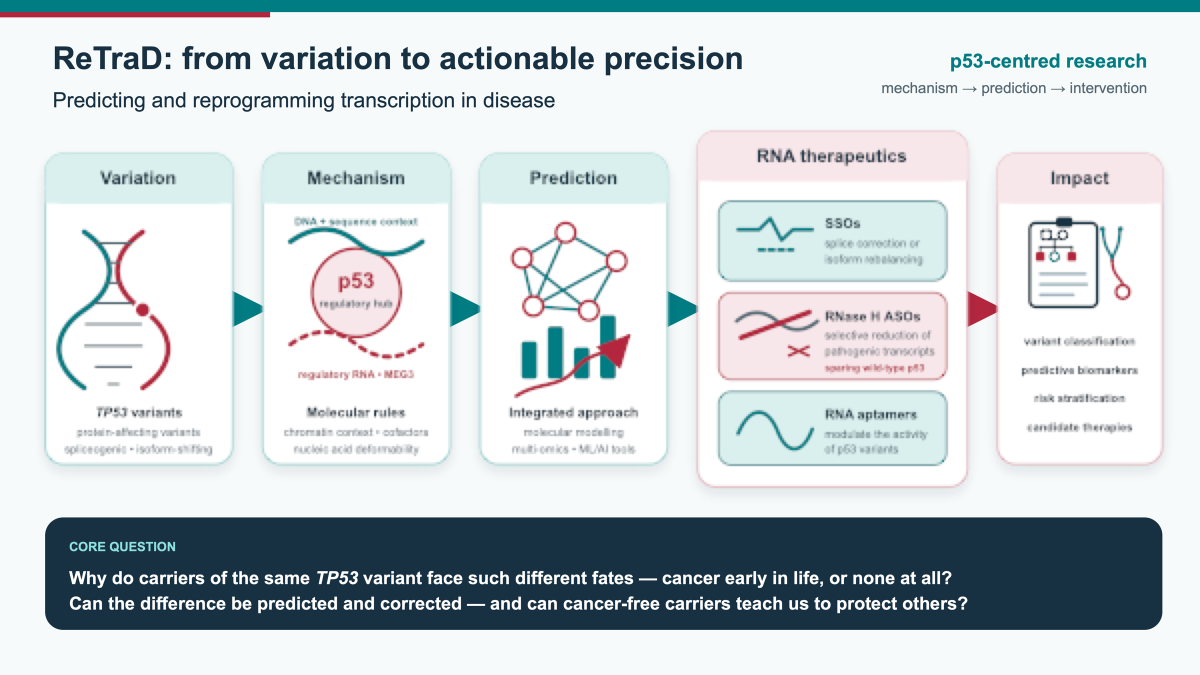
Almost every cancer carries a broken gene-regulation programme. In our team, ReTraD, we study TP53, the gene most often broken in human cancers and the cause of Li–Fraumeni syndrome (LFS), an inherited cancer predisposition. Outcomes among LFS carriers differ greatly: most develop aggressive cancers early in life, some stay cancer-free into old age. We ask why, if the outcome can be predicted and corrected, and what cancer-free carriers can teach us to protect others.
We build mechanistic, predictive models of transcriptional dysregulation using atomistic simulations of how p53 and related factors read DNA and regulatory RNAs, multi-omics data, variant and isoform analysis and ML/AI tools. Predictions are tested with experimental and clinical partners at IAB and abroad.
Three questions drive our work:
1. What directs p53 to activate, repress or ignore a gene in a given chromatin and cellular context?
2. How do TP53 variants alter mRNA splicing and p53 isoform balance, and thereby cancer risk?
3. How can RNA therapeutics counteract pathogenic TP53 variants – for example, with oligonucleotides that correct aberrant splicing, restore p53 isoform balance or selectively reduce mutant transcripts?
Our results have clinical implications: better classification of variants of uncertain significance, biomarkers of risk and response, and rational oligonucleotide design. ReTraD adds a mechanistic, predictive computational layer to IAB's experimental and clinical programs.
Anna REYMER
Team leader, Inserm Research Chair
+33 7 63 70 90 69

Our research axes
Why does p53 activate one gene, repress another and ignore a third? p53 and related transcription factors recognise DNA response elements (REs) and regulatory RNAs such as the lncRNA MEG3. RE flanking sequence, nucleic acid deformability, chromatin accessibility and methylation shift these interactions. We employ molecular simulations guided by multi-omics data to interpret p53–nucleic acid recognition and design ML/AI tools to predict which genes p53 activates or represses in a given context.
Learn more
How does a TP53 variant become a cancer risk? One route bypasses the protein: exonic and intronic substitutions can activate cryptic splice sites, and the resulting transcripts can range from fully disrupted to partly functional. We study splicing across the whole gene, and how variants shift the balance of p53 isoforms between tissues. We design ML/AI tools that predict from sequence not just whether a variant is spliceogenic but also the isoform outcome, and what that means for carriers.
Learn more
How can a pathogenic TP53 variant be counteracted? We design splice-switching oligonucleotides to redirect aberrant splicing or rebalance isoforms, RNase H-competent antisense oligonucleotides (ASO) to lower harmful transcripts, sparing wild-type p53, and RNA aptamers to modulate the activity of p53 variants and related transcription factors. To streamline the design of RNA therapeutics, we employ computational chemistry and molecular modelling together with ML/AI tools, so that fewer candidates need to be made and tested.
Learn more
Our major publications
See all publicationsOur collaborations
- At IAB: André Verdel (ncRNA and chromatin), Andrés Palencia (structure-based design), Christophe Arnoult (TP53 isoforms in fertility).
- In France: Laurent Le Cam (IRCM Montpellier), Damien Grégoire (IGMM Montpellier).
- Internationally: Christian P. Kratz (Hannover Medical School), Paola Monti and Nadia Bertola (IRCCS Ospedale Policlinico San Martino, Genoa), Yari Ciribilli (CIBIO, University of Trento), Roger Karlsson and Volkan Sayin (University of Gothenburg).
Our technologies
- Protein–nucleic-acid modelling, DNA/RNA mechanics, atomistic molecular dynamics, free-energy calculations, molecular docking, RNA structure prediction
- Multi-omics integration: ChIP-seq, ATAC-seq, RNA-seq, CLIP-seq (ENCODE, TCGA, GTEx, GEO)
- Variant, splicing and haplotype analysis; TP53 isoform quantification; SpliceAI, Pangolin
- Interpretable machine learning (ML/AI) and deep learning for regulatory genomics; HPC and GPU computing
- Structure-guided ASO/SSO and aptamer design; validation with partners (minigene assays, cell and patient-derived models)